
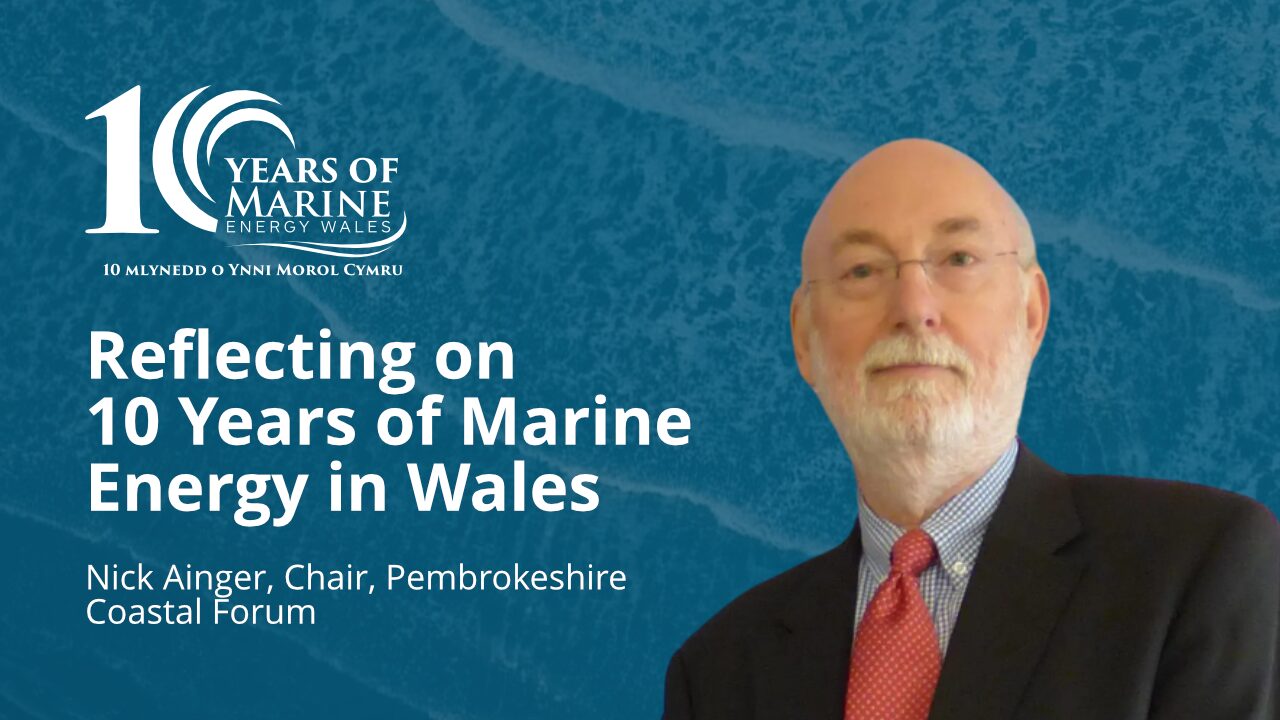
Nick Ainger has decades of experience in public service, government and industry. Before being elected Labour MP for Pembroke in 1992, he worked in Pembrokeshire’s energy sector.
During his parliamentary career, he served in a range of senior government roles, including as Parliamentary Private Secretary to three Welsh Secretaries, a government whip at the Wales Office and DEFRA, and later as Minister at the Wales Office.
A long-standing advocate for environmental and coastal issues, he won the BBC Environment Campaign of the Year Award in 1996 for his campaign to secure an independent inquiry into the Sea Empress disaster.
After leaving government in 2007, he served on the Treasury Select Committee, contributing to major inquiries into the banking crisis. Today, alongside his continued public and community involvement, he serves as Chair of the Pembrokeshire Coastal Forum Board.
Tell us about your current role and your connection to the Welsh marine energy sector, what led you to where you are today?
I have been involved with Pembrokeshire Coastal Forum (PCF), since its formation in 2000. Looking back, there was very little discussion around marine energy at that time. I think what triggered it was the work that Richard Ayers did.
Richard was a local engineer who had worked at Pembroke Power Station. In 2002, he developed the idea of a marine turbine. The initial prototype was a moored barge with a tidal turbine suspended from it, which was tested off Rudder’s Boatyard.
That project was funded by the National Park, which demonstrated incredible foresight and bravery at the time. It helped establish Pembrokeshire as a place with real potential to develop renewable energy.
Not long after, Marine Energy Pembrokeshire was formed to bring people together and address issues around supply chain, consenting, and licensing, whilst the turbine itself was still developing. It was through this work we got to know Martin Murphy, who came on board as a fellow director of PCF.
The Welsh Government were following our developments closely and were impressed by what we had achieved. But, they quite rightly recognised that this wasn’t an issue unique to Pembrokeshire. Marine energy presented opportunities for the whole of Wales, particularly in Anglesey which has strong tidal stream resource.
They encouraged us to expand our focus, and that is when Marine Energy Pembrokeshire became Marine Energy Wales. We were formed in 2016, just a few months after the Delta Stream tidal turbine was deployed into Ramsey Sound.
Looking back over the last 10 years of the sector, what do you think has changed the most?
If you had told me in 2016 that some of the biggest energy companies in the world would secure consent to develop multi-billion-pound developments in the Celtic Sea, I would have been very surprised.
The speed at which the industry has developed over the last decade has been remarkable, and Marine Energy Wales has been at the heart of it, bringing together the key players needed to develop the sector.
The annual Marine Energy Wales conference is a great measure of that growth. The first event involved a handful of people meeting in a hotel in Pembroke Dock. Today, it attracts hundreds of delegates and exhibitors from across Europe.
Has there been a moment in the last decade that made you stop and think, “this industry is actually happening?”
The fact that the sector has gained support from successive First Ministers, from Rhodri Morgan onwards, is testament to what has been achieved. The backing we have received from Welsh Government has been absolutely essential and, I am sure, will continue under the Plaid Cymru-led government.
I do not think there has been one single defining moment, but seeing the Delta Stream turbine deployed at Ramsey Sound was significant. The major Celtic Sea developments now in the pipeline demonstrate that momentum continues to build.
In Anglesey, projects are moving from prototype to full array, and across Wales the supply chain is increasingly aware of the opportunities available, thanks largely to the work of MEW over the years.
“I’m sure in 10 years’ time there will still be issues and challenges, and there will still be a role for Marine Energy Wales.”
What does Marine Energy Wales do that people in the industry might not see or fully appreciate?
I think if Marine Energy Wales had not been created when it was, somebody would have had to create something similar. The sector was so novel that everyone – developers, regulators, consenting teams, were trying to navigate challenges they had never encountered.
At the same time, there was an economic imperative driven by climate change, and the decline of traditional energy industries in Wales.
MEW is absolutely at the heart of what Pembrokeshire Coastal Forum is all about; bringing people together to address challenges and try to solve problems. All of our projects are like that, but because MEW is pan-Wales, it can connect supply chain businesses from Ynys Môn in the north, to companies across south and west Wales. It also brings together government, regulators and licensees like The Crown Estate.
if someone reads this article in 2036, what do you hope they’ll say about what the sector has achieved? What are your hopes for the next 10 years?
Hopefully by 2036 we will see electricity from floating offshore wind coming ashore, and activity in North Wales really taking off. The groundwork has been done brilliantly there, and hopefully we will also tidal stream delivering reliable power at scale.
I would love to see by then a stable marine energy industry in Wales, creating significant employment opportunities across the supply chain. That includes jobs in turbine development and deployment, as well as growing opportunities in operation and maintenance.
I’m sure there will still be issues and challenges, and I’m sure there will still be a role for MEW in ten years’ time. Even as the sector moves through the development stage and into full-scale production, there will still be a need to bring people together, address challenges and support the sector’s growth.