
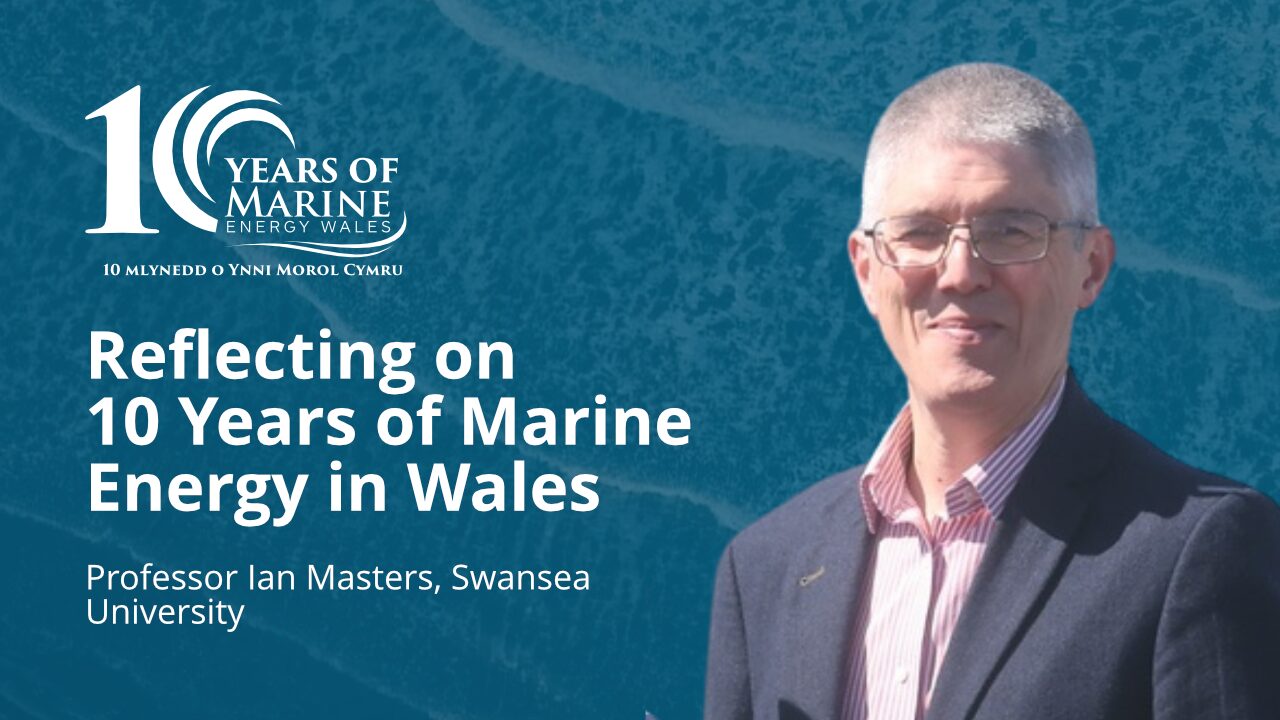
Professor Ian Masters is Head of the Centre of Expertise in Ocean Energy and Hydrogen at Swansea University. His research focuses on how to generate power from the sea.
Ian has been involved with Marine Energy Wales from the very beginning.
Tell us about your current role and your connection to the Welsh marine energy sector, what led you to where you are today?
I am a Professor at Swansea University, and I run a Centre of Expertise in Ocean Energy and Hydrogen. I have been involved with marine energy since 2001, and have worked with most of the projects in the South Wales area that have happened since then.
Looking back over the last 10 years of the sector, what do you think has changed the most?
In terms of tidal energy, we’ve moved away from individual devices and prototypes and toward arrays, and we’ve seen huge progress on technology development. We’ve seen various wave devices come through, all of which have had their merits and their issues, and we’re now starting to see offshore wind here in South Wales, as well as wind farms on the North Wales coast, some of which I don’t think existed back in 2016.
As an academic publishing in journals and papers, I’ve got a record of exactly what I was doing in 2016. At the time, we were publishing work on ocean turbulence and we were doing our first computational fluid dynamics models of tidal turbine farms in real channels. All of that is still relevant today.
Has there been a moment in the last decade that made you stop and think, “this industry is actually happening?”
We always try to ensure our research is going to be useful to industry, and so to some degree, our success is intertwined with that of the sector.
The point I probably felt “this is really going to happen”, was when those first CfDs were awarded to tidal projects. Having seen the success of the CfD process in wind, to get to the point where someone in government is prepared to put money in and scale up these projects was when it felt like things were finally starting to happen.
In your opinion, if anything, what’s still holding the marine energy sector back today and what are the biggest challenges it still faces?
I think funding is the biggest challenge for the sector, but it has two different root causes. The first problem is those politicians that are trying to avoid climate change, which is here and now – we only have to look at the hot weather recently and the way it’s been reported. Our weather has changed, our climate has changed, and yet people are still thinking it’s okay to exploit fossil fuels, and that’s one narrative we’re fighting against.
On the other side, we’ve got some really good renewable technologies like onshore wind and solar which are so cheap, so cost effective, but they make the others seem expensive. We are not going to get all the way to net zero, it is not possible to take all the fossil fuels out of our system, without these offshore technologies, but we are going to have to pay a bit more than the very cheap onshore technologies.
Underlying it all is a hesitation to fund this sector properly. If we fund deep water wind properly and the costs come down, then we’ll think great, we’ve done that well. If we fund tidal properly, if we fund wave energy to the point it makes that breakthrough, we’ll have opened up all these different energy sources we currently don’t have, and it’ll help us on the route to net zero.
“We’ve made immense progress and technology is certainly moving in the right direction, but we must now keep up those political and social discussions.”
Have there been any tough moments or big challenges you can remember for the sector or in your personal career, and what did they teach you?
My biggest career challenge was a decision I made to create a real marine energy device, in real seas. It was quite ambitious to attempt that as a university, and it probably dominated my research for about 5 years. It was COVID at the time, so we had lots of challenges, some long days on site, and some setbacks, like all technology projects do.
But we built a turbine, we put it in the water at META – the first marine energy device to be tested there, and now we have published open source drawings of tidal turbine technology which hopefully can be picked up and developed further, so it was a really exciting thing to have done.
Since then, META and Rudders Boatyard have been able to use the floating platform from that project to test other things, so we’ve had some good spin-offs from that first project and we’ve done some good science along the way, but it was demanding at times.
What role has Marine Energy Wales played in your own career or organisation and for the wider industry?
I think MEW is good at keeping what we do grounded in the industry’s requirements. It keeps us away from research, for research’s sake, and it keeps us in touch through all the interactions, engagement and the relevant workshops and meetings.
I think what MEW does best is it builds trust. It’s not advocating for one specific technology for example, and I think it’s quite mature in the way relationships are built.
In the beginning, during the transition from Marine Energy Pembrokeshire to Marine Energy Wales, I think there was some friction around how it would be perceived. But the work that’s been done to make it a truly Wales-wide organisation, and to see the North Wales developers speaking at the recent conference is brilliant. MEW is very much a national organisation now which represents everybody.
if someone reads this article in 2036, what do you hope they’ll say about what the sector has achieved? What are your hopes for the next 10 years?
My office is on the Bay Campus at Swansea University, and I look out over the beach and towards Port Talbot. I’m just waiting for the day when I can see wind turbines, or wind turbine components, being floated out of Port Talbot harbour and past my office window. That will be the point where I know we’ve really achieved something.
We’ve made immense progress and technology is certainly moving in the right direction, but I think now we’ve got to keep up those political and social discussions. This is homegrown technology, this is local, well-paid jobs, and while in the short term it might look like more on your electricity bill, the potential impact for the future is huge.
My worry is that the political landscape will change and resources will get pulled away. Perhaps in 10 years’ time we will have won the economic battle and it will be obvious that offshore renewables is the way to go, but right now that’s not the case.
In wave technology, we already have a recognised stage-gated process for technology development, which removes risks. In deepwater wind, if there’s a lot of money spent on something really big and it doesn’t quite work, that is not the point to cut funding. The point is to work out what didn’t work, re-engineer it, go again and learn from that mistake.
My ask would be when the technology goes wrong, don’t just cut the funding – find out why and work through that technical problem, even if it takes more development money. We’ve seen it in fixed bottom offshore wind on the East Coast – there have been some technical problems, but they’re now generating very cost-effective electricity.