
Blog post written by Pembrokeshire College
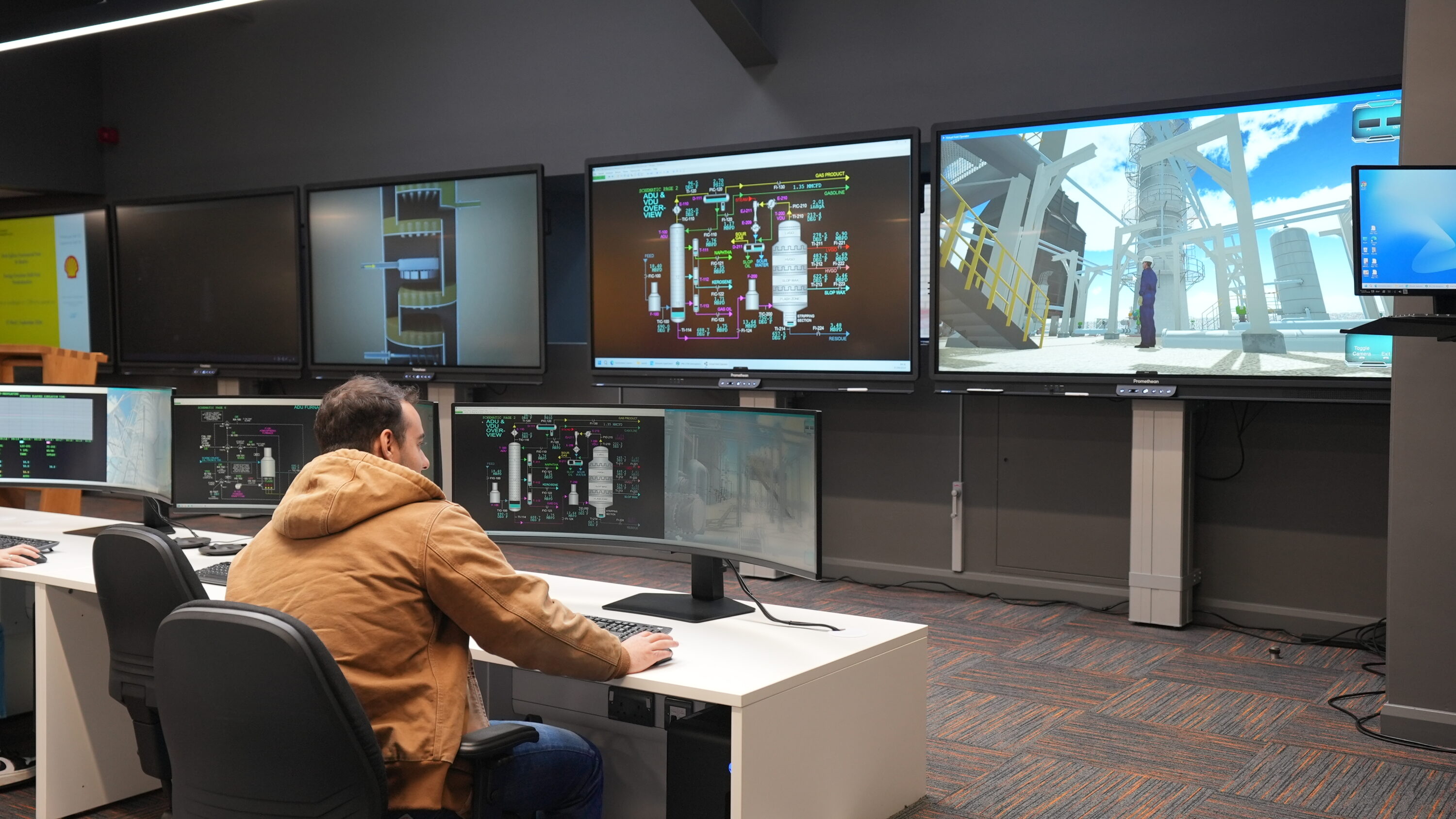
Pembrokeshire’s Energy Transition Skills Hub has successfully trained hundreds of learners using specialist control room systems, marking a significant milestone in its mission to develop skills for the future energy sector.
Over the last few years, the Hub has established itself as a leading facility, delivering training in Control Room Operator software, with a focus on both existing and emerging technologies that support the energy transition.
The project is supported by Shell UK and the Swansea Bay City Deal Skills and Talent Programme. Their involvement has helped ensure the training remains closely aligned with industry needs and regional skills priorities, and has been instrumental in enabling the Hub to deliver an ambitious and forward-looking programme.
By the end of 2026, 600 learners will have completed training using these control room systems, representing a significant contribution to the regional and national talent pipeline for the energy sector.
As part of the programme, the Hub has been developing innovative new control system simulations. The first of these, a Hydrogen Electrolyser system, is now fully functional and available for learners. Development is also well underway on Solar, Tidal and Offshore Floating Wind systems, which are expected to be operational in the coming months.
The development of these systems has presented a number of challenges, with the aim to reflect the control systems that will be developed over the coming years. In many cases, the devices and infrastructure being simulated have not yet been fully designed, and much of the available technical information is confidential and commercially sensitive. This has required the project team to work carefully and creatively, bringing together multiple systems and integrating them into a single, coherent control room environment.
Despite these challenges, collaboration with technology developers has been a major strength of the project. Developers have provided valuable insight and guidance to the software development teams, enabling the creation of credible, functional simulations that reflect how these technologies are expected to operate in practice. The ability to bring together different systems into a single control room setting has been particularly valuable, offering learners a holistic view of how future energy infrastructure will be monitored and managed.
The resulting control room systems are now recognised as an important resource for the sector, providing a rare opportunity to experience realistic working simulations ahead of large-scale commercial deployment. This allows learners, educators and industry stakeholders to explore new operational concepts, test scenarios and build confidence in technologies that will play a vital role in the transition to net zero.
“We are pleased to be working with Pembrokeshire College to give 600 learners from the college and wider community the skills to take advantage of the emerging opportunities in the energy sector. The Pembrokeshire energy transition skills hub is one of three skills hubs developed by Shell UK and is part of Shell UK’s Skills Transition programme which aims to support 15,000 people into work, with a focus on the energy transition”.
Jenny MacDonald, Head of Social Investment, Shell UK
“Supporting this project has enabled current students to experience groundbreaking technology and gain qualifications that will give them opportunities in a range of different businesses. As we move into the new world of wind, hydrogen and solar power there will be a demand for skills in control room operations and the Regional Learning and Skills Partnership are pleased to make a financial contribution to what we hope will be a longstanding skills training project within Pembrokeshire.”
Jane Lewis, Regional Partnership Manager, Regional Learning and Skills Partnership South West
Looking ahead, the Energy Transition Skills Hub Pembrokeshire will continue to build on this strong foundation, expanding its training offer and strengthening collaboration with industry and regional partners to ensure that the skills being developed today are aligned with the technologies and opportunities of tomorrow.