
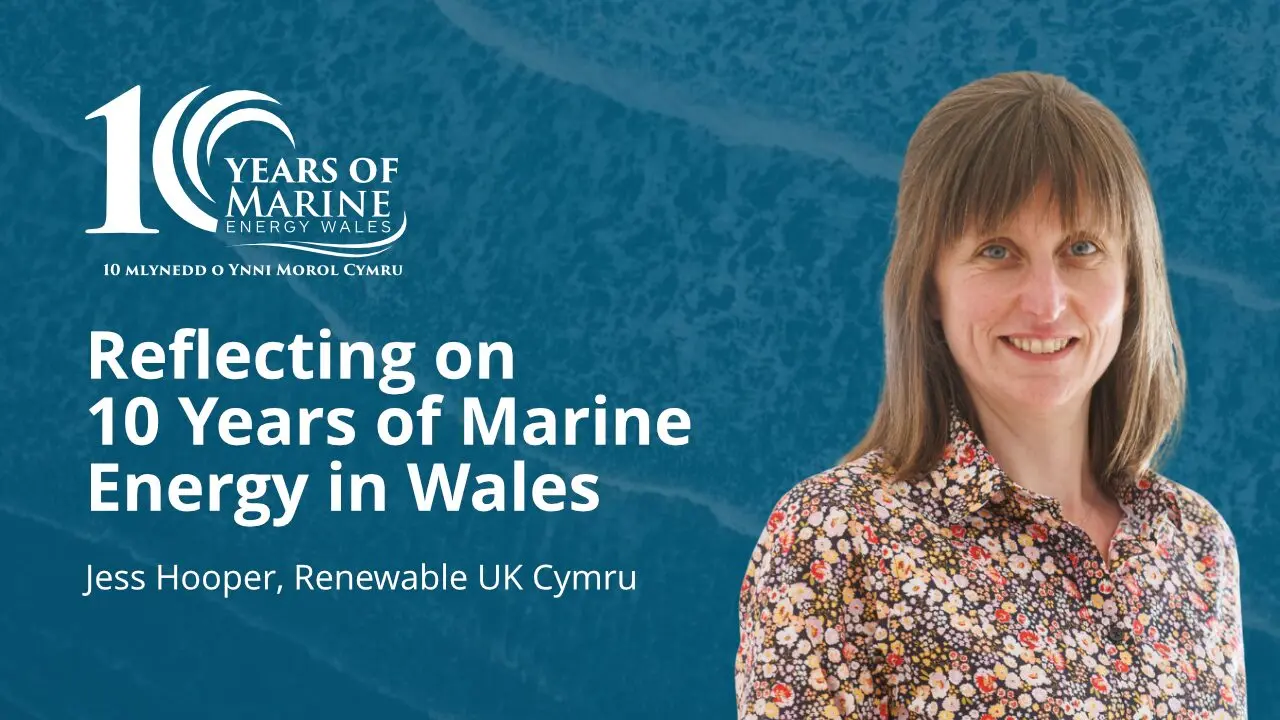
Jess Hooper is Director of Renewable UK Cymru (RUK Cymru), the Welsh arm of the UK’s leading renewable energy trade association.
RUK Cymru has specific interests in Welsh onshore wind and offshore fixed-bottom installations, as well as floating offshore wind in the Celtic Sea.
Jess’s interest and passion in renewables spans back to her school days. Jess was MEW’s Programme Manager between 2020 and 2022.
Tell us about your current role and your connection to the Welsh marine energy sector, what led you to where you are today?
It all started with a GCSE project, and some coursework around what we could do as individuals to halt climate change. Being based on a farm, I decided to do a case study on how installing a wind turbine could help decarbonise the farm. That was in 2000, and by 2002, we’d installed the first privately owned commercial wind turbine in Wales. I suppose that was what initially kick-started my passion.
Growing up in Milford Haven, surrounded on three sides by oil refineries, it really highlighted the need to move away from those carbon intensive industries, and renewables and green energy felt like a career path I wanted to pursue.
Looking back over the last 10 years of the sector, what do you think has changed the most?
I think the attention on marine renewables in Wales now is better than it’s ever been, thanks largely to the Labour Government in Westminster and decades of Labour support in Wales. That sense of belief that projects can be delivered and achieved is unrivalled, and that is really helping to seal our position in the UK and globally.
I think the last decade has been quite visionary, with Welsh Government, The Crown Estate and Menter Môn in North Wales in particular, being able to look ahead to where we needed to be and how we get there. There have of course been several challenges over the last ten years too, but the momentum does feel very real at the moment. The critical thing now I think will be maintaining that momentum through various political cycles.
Has there been a moment in the last decade that made you stop and think, “this industry is actually happening?”
The momentum for the Celtic Sea was phenomenal in 2019 and 2020. That was around the same time we set up the Celtic Sea Developer Alliance (CSDA) and started to look at the Celtic Sea Cluster. It was invigorating to see so much passion and interest coming into a small offshoot off the southwest coast of Wales.
When we were given the opportunity to sit in the room with The Crown Estate, and 150 people to hear how Leasing Round 5 would be run, what it would look like, and what it could mean for the region in terms of the socio-economic value for Welsh communities, it made me realise how much this industry could benefit us here in Wales.
Have there been any tough moments or big challenges for the sector or for you personally during your career? if so what did they teach you?
In 2016, I was working for Marine Current Turbines (MCT), and at the time they were pioneers in the UK. They’d installed Seagen in Strangford Loch, and it was a phenomenal feat of engineering.
That year the Contracts for Difference (CfD) scheme was introduced, replacing the renewable obligation certificate, and it was a very different mechanism for supporting technology, moving away from subsidies and more toward actual revenue support.
That shift really brought to the fore the fact that tidal was a nascent technology, and now coupled with a new financial support mechanism, it became clear that it was quite high risk.
For MCT, the momentum was there, the financial support of a big German company was there, but UK Government at the time took the decision that the project wasnt worth supporting, even though the company had been bought by Siemens, who are global leaders.
It all really drove home the reality of how vulnerable marine energy projects and early technologies can be, and the importance of consistent political backing. Siemens subsequently divested and the company shrank from a team of 80 to just 16 people. I think that was probably one of the most challenging periods.
In your opinion, what’s still holding the marine energy sector back today and what are the biggest challenges it still faces?
Pipeline and grid. We cannot install at the pace and scale that we want to as a nation here in Wales unless we upgrade the grid. UK Government are doing great things to expedite things, and the Scottish Government is doing the same. Welsh Government really need to step up and think about grid.
In addition, I think the fundamental thing across the board is and has always been the pipeline. Unless we have confidence that an investment today is going to continue to pay out in a decade’s time, people aren’t going to pursue it. The Crown Estate and UK Government must assure ports and the supply chain that Wales remains of interest and that they are making a dedicated commitment to bringing it forward.
“I think Marine Energy Wales has always punched above its weight. Its ethos is to knuckle down and try to do your damnedest to make a difference.”
What role has Marine Energy Wales played in your own career or organisation and for the wider industry?
I started out in MEW as a project developer, specifically brought in to work on the consenting for META, and I’d had a fairly varied career before that – I’d done onshore wind site prospecting, I’d worked for MCT, and had experience in tidal stream development, so I had a broad understanding of things, particularly around finance, risk and investment.
Coming into Marine Energy Wales, I was excited about META. It was an opportunity to bring renewables to Wales in a way that hadn’t been done previously, like the success of EMEC and what that has done for Orkney.
Soon after, I became MEW’s Programme Manager and was reluctantly thrust into the political sphere. It quickly became quite apparent that politicians were completely missing the point in some cases, and at that time it seemed like a matter of helping connect the dots. When you can speak to politicians directly, help them understand the industry and encourage them to work together across parties and interests, you begin to chip away at some of the doubts and uncertainty, and you can begin to create a positive policy environment. It dawned on me then that there was something we could do, and that almost certainly inspired me to be here doing what I’m doing today. If that opportunity hadn’t come up, I would never be here, I’d probably still be developing projects.
What does Marine Energy Wales do that people in the industry might not see or fully appreciate?
Personally, I think Marine Energy Wales has always delivered and punched above its weight. Having worked there, I know the ethos is to knuckle down and try to do your damnedest to make a difference, and I’m not sure people necessarily see that, because it’s all happening behind the scenes.
Speaking from experience, the extra hours that go in behind the scenes to get things to happen – events, convening, conversations that might not otherwise happen, connecting people that don’t yet know each other, the value of all of that can’t be underestimated.
Being pan Wales, MEW is doing that very challenging job of balancing north, south, east and west interests, and I think forming those bridges is something that no one else does as effectively.
if someone reads this article in 2036, what do you hope they’ll say about what the sector has achieved? What are your hopes for the next 10 years?
By then, the Test & Demo sites should all have been consented, constructed and operational. Hopefully the young people who are now taking part in programmes like Destination Renewables will be realising their careers – something I, as someone educated here in Pembrokeshire, never thought would be possible. Most of those exciting and interesting careers seemed beyond my reach in Pembrokeshire, and 20 years ago they were. Now, I think renewables will hopefully be able to offer good, solid jobs, close to people’s family, in a way that the oil refineries did back then.
I would very much like to be able to say in 10 years that we’ve created a thriving economy, that political support through the next decade doesn’t ebb and flow as it has over the last two decades, and that instead we have a consistent market, a consistent investment environment, and fundamentally we’re making a difference to climate change needs so that we’re not sat here in 2036 sweltering in 40 degree heat.